
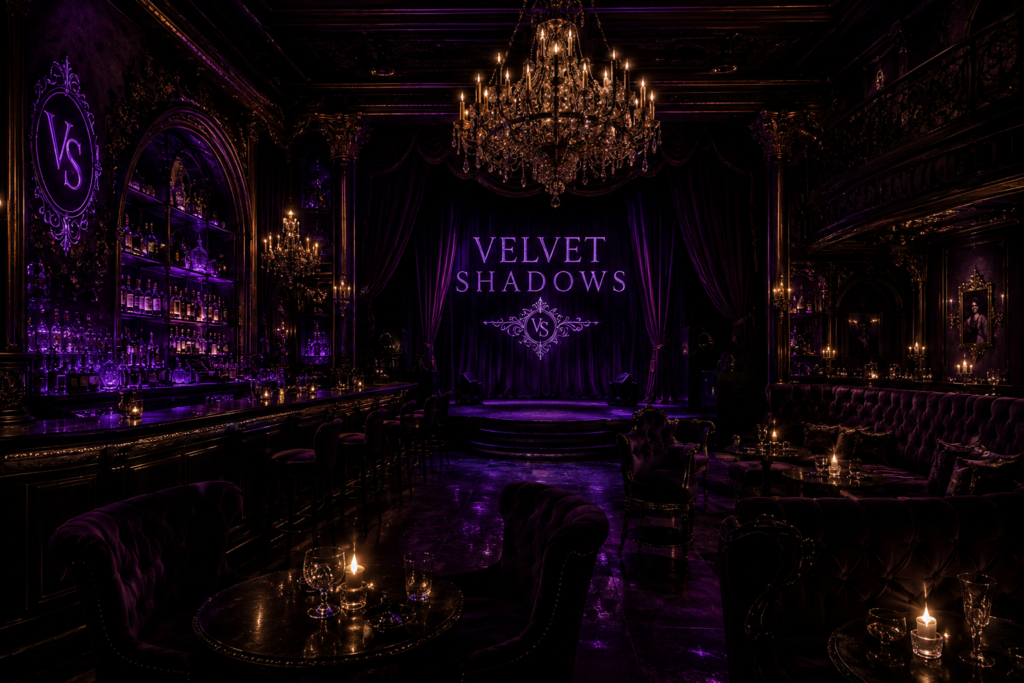
Velvet Shadows was less of a nightclub and more of a cathedral built for temptation. Hidden behind an unmarked black door in the heart of the city, the club breathed with an atmosphere of dangerous elegance the moment someone stepped inside. Purple light spilled across polished black marble floors while towering chandeliers dripped gold and crystal overhead like suspended stars caught in eternal midnight.
The air carried the scent of expensive liquor, candle wax, velvet, and secrets.
Along the walls, dark velvet drapes framed private alcoves where whispered conversations blurred together with low laughter and forbidden promises. The long obsidian bar glowed beneath violet backlighting, displaying rows of rare bottles like sacred relics. Every detail of the club was intentional — gold trim carved into the architecture, black velvet seating curved like thrones, flickering candlelight reflecting off crystal glasses and pale skin alike.
At the center of the room stood the stage.
Heavy curtains embroidered with the crest of Velvet Shadows hung behind it, illuminated in haunting violet light that seemed to pulse with its own life. Music drifted through the club like a spell — sensual, hypnotic, impossible to ignore. Some nights the stage belonged to performers. Other nights it belonged to creatures far more dangerous.
Velvet Shadows attracted artists, socialites, witches, predators, and the beautifully broken. To outsiders it was an elite gothic nightclub known for decadence and mystery. To those who truly understood what happened within its walls, it was neutral ground — a sanctuary wrapped in seduction where power was traded as freely as desire.
And at the center of it all, hidden somewhere beneath the glow of purple chandeliers and the weight of old magic, was Lucien Voss.
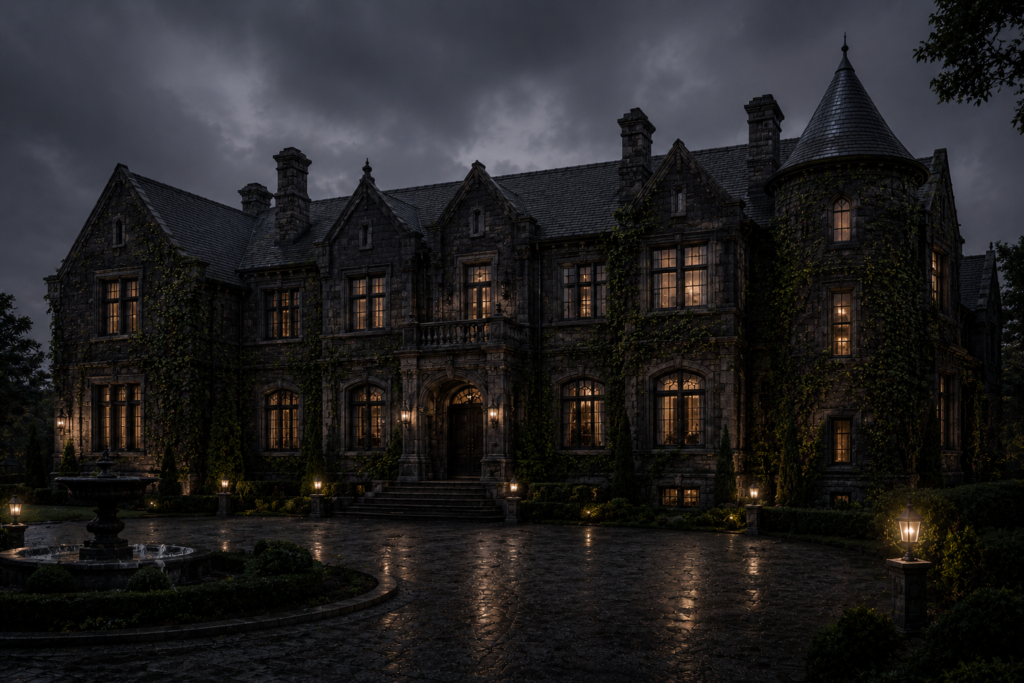
Voss Estate sat hidden beyond miles of winding private roads and ancient forest, isolated from the modern world as though the land itself wished to keep its secrets buried. The property stretched across acres of towering trees, iron fencing, and immaculately maintained gardens illuminated by soft lantern light after dusk. A long curved driveway cut through the estate toward the mansion at its center, where dark stone walls rose against the sky like something untouched by time.
Voss Mansion itself resembled a gothic castle more than a traditional home.
Built from deep gray stone and standing two stories tall, the mansion carried an intimidating elegance softened only slightly by the ivy that climbed its exterior walls in thick twisting strands. Tall arched windows reflected moonlight like black glass during the night, while warm golden light glowed faintly from within, creating the illusion of life against the cold stone exterior.
Steep gables, carved stonework, wrought-iron balconies, and a circular tower gave the estate an old-world grandeur that felt centuries removed from the city below. Rain often lingered on the stone pathways surrounding the house, carrying the scent of wet earth, cedar, fireplace smoke, and old books through the night air.
Inside, the mansion was breathtaking in its scale.
Dark hardwood floors stretched through endless corridors lined with towering bookshelves, antique portraits, velvet furnishings, and flickering candlelight. Crystal chandeliers hung overhead while enormous fireplaces crackled softly in rooms that were far too large for a single occupant. The mansion held eight expansive bedrooms, formal dining halls, private studies, hidden passageways, and the massive Archives — Lucien’s private library filled with texts older than some nations.
Yet despite its beauty, Voss Mansion carried an unmistakable loneliness.
The halls were too quiet. The dining room table was set for more people than ever arrived. Entire wings of the estate sat untouched for weeks at a time, preserved more out of memory than necessity. Music occasionally drifted through the mansion late at night simply to break the silence, and candlelight often burned in empty rooms because Lucien had long ago decided darkness felt heavier when the house was completely still.
To outsiders, the estate belonged to Lucien Voss — an eccentric and wealthy nightclub owner known for his privacy, charm, and unsettling presence.
But to those who truly understood what hid behind the ivy-covered walls, Voss Mansion was far more than a home.
It was a sanctuary wrapped in shadows.
A monument to immortality and grief.
And a place so steeped in secrets that even the walls seemed to whisper after midnight.
The Sanctum was not a room in the traditional sense.
It did not exist on any blueprint of Voss Mansion, nor could it be stumbled upon by wandering through the estate’s endless halls. The Sanctum revealed itself only when summoned — awakened by ancient magic tied directly to Lucien Voss and the bloodline that came before him. A whispered word in the correct place would cause reality itself to bend. Walls shifted. Shadows deepened. Doors appeared where none had existed moments before.
And when the magic faded, the room vanished without a trace.
The Sanctum could emerge from any part of the mansion. A library wall might split open into darkness. A fireplace could reveal a hidden stone staircase descending beneath the estate. Even an ordinary hallway might transform for a brief moment into an arched doorway illuminated by violet candlelight. To anyone else, it would appear impossible.
To Lucien, it was simply home.
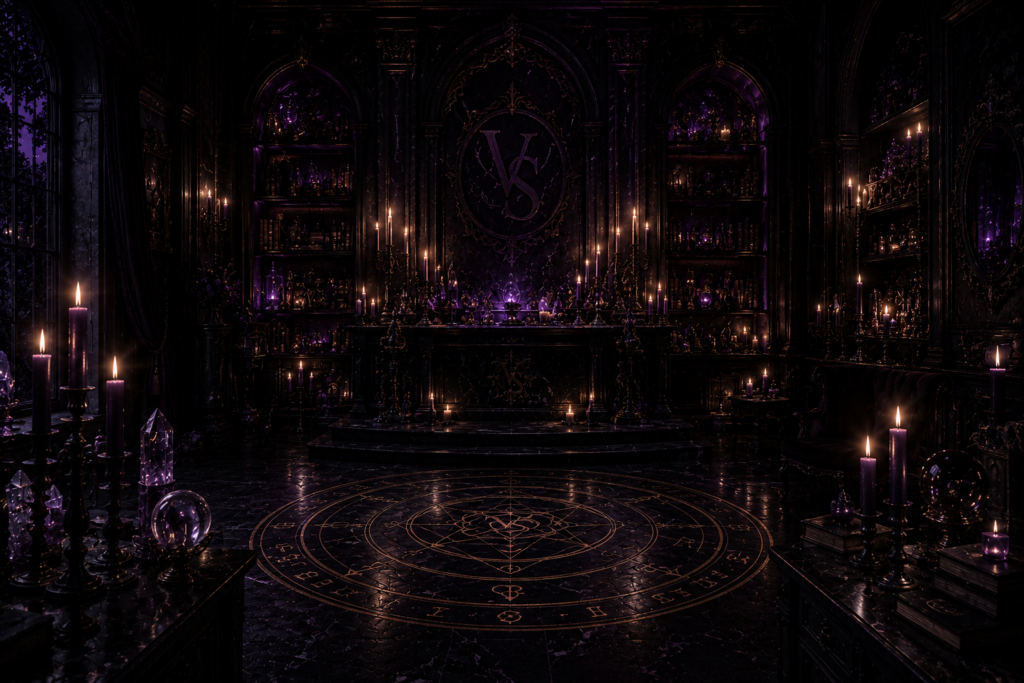
Inside, the Sanctum felt ancient beyond comprehension — a place untouched by modern time. The chamber was vast and cathedral-like, constructed of black stone that absorbed candlelight rather than reflected it. Gothic arches disappeared into shadow overhead while purple flames flickered endlessly in wrought-iron candelabras lining the walls. The air carried the scent of old parchment, incense, cedar smoke, and ozone left behind by magic.
At the center of the room rested the altar.
Carved from polished obsidian veined with silver, the altar stood atop an intricate ritual circle etched directly into the dark marble floor in gold and violet sigils. The symbols shifted subtly when spells were cast, glowing faintly as if alive beneath the stone. Crystal spheres, ceremonial daggers, ancient grimoires, and relics collected across centuries rested in carefully arranged order around the chamber.
Unlike the rest of the mansion, the Sanctum did not feel lonely.
It felt aware.
The room hummed with restrained power, responding to Lucien almost like a living extension of himself. Candles ignited when he entered. Shadows shifted around him protectively. Shelves opened at a gesture. Certain books would only reveal themselves if he called for them by name. The deeper one ventured into the chamber, the older the magic felt.
This was not the version of Lucien the public knew.
Velvet Shadows belonged to the charming nightclub owner.
Voss Mansion belonged to the immortal aristocrat.
But the Sanctum belonged to the witch.
It was the only place in the estate where Lucien allowed himself to be completely honest about what he truly was — not a man pretending to survive within modern society, but a centuries-old being shaped by ritual, blood, power, and grief.
And for those few who were ever invited inside, the Sanctum carried one unshakable realization:
The room did not merely appear for Lucien.
It obeyed him.
The Void was not a place in the traditional sense.
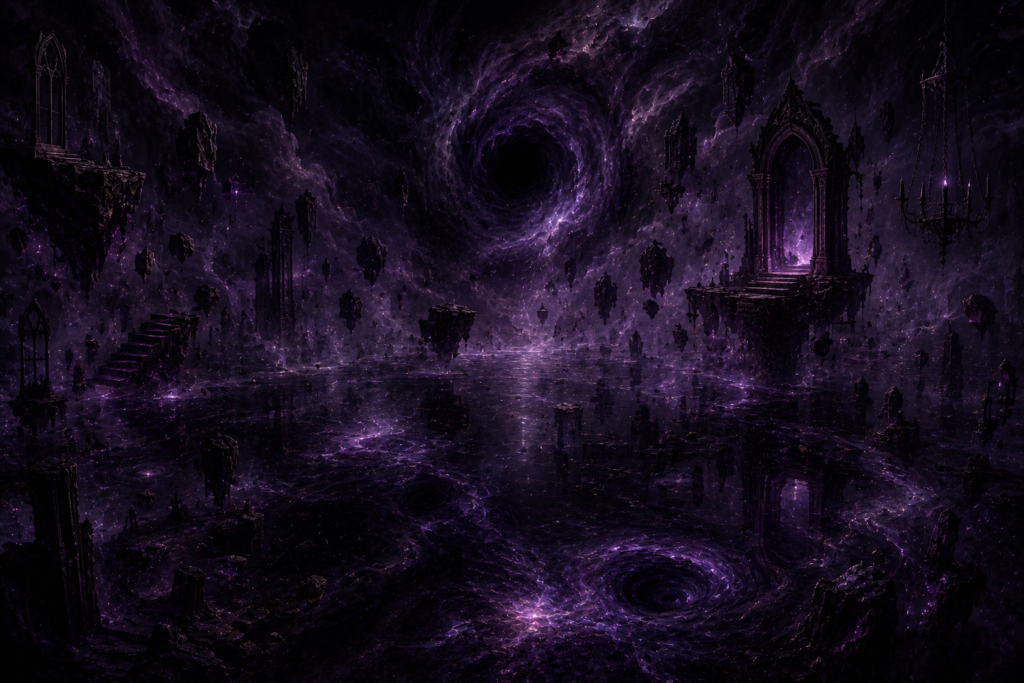
It had no true beginning, no horizon, no sky, and no earth beneath one’s feet — only the unsettling illusion of those things. Those who entered often described it differently, as though the realm reshaped itself around memory, fear, and desire. To some it appeared as endless darkness drowned in violet light. To others it became oceans of black glass reflecting dead stars that did not exist anywhere in the mortal world.
The Void was silence given form.
Sound behaved strangely there. Footsteps echoed seconds too late. Voices felt muffled, as though reality itself struggled to carry them. Time moved inconsistently, stretching and collapsing without warning. A person could spend minutes within the Void only to discover hours had passed outside of it… or the reverse.
The air itself felt alive.
Shadows drifted unnaturally through the endless expanse like living things observing from the corners of perception. Fragments of impossible architecture floated in the distance — broken staircases leading nowhere, cathedral arches suspended in empty space, crumbling doors opening into darkness deeper than night itself. Some claimed these were remnants of forgotten realities. Others believed the Void simply enjoyed imitating places mortals could almost understand.
No one truly knew.
Magic inside the Void became unpredictable and dangerously amplified. Emotions bled into reality there. Fear could become tangible. Grief lingered like a storm in the air. Rage could twist the environment itself. Even experienced witches risked losing themselves if they entered the Void while emotionally unstable.
And yet despite its danger… the Void was seductive.
There was a terrible beauty to it. Violet currents of energy moved beneath reflective black surfaces like veins beneath skin. Ancient whispers drifted through the darkness just beyond comprehension. Some who touched the Void described feeling more powerful than they ever had before. Others described the horrifying sensation of the Void staring back at them.
Because the oldest texts all agreed on one thing:
The Void was not empty.
It was aware.
Long before witches existed, before vampires walked among humanity, before kingdoms rose and collapsed into dust, the Void had already been there — ancient, patient, and endlessly watching the fragile worlds surrounding it.
Most supernatural beings feared it.
Lucien Voss did not.
That frightened people far more than the Void itself.